Insulation thickness calculation
Thickness determined from surface temperature, heat loss, condensation control and economic optimisation; calculation basis, boundary conditions and assumptions are stated in the report.
ERATHERM is an engineering company working on thermal, cryogenic and acoustic insulation for process plants and for defence, aviation and space programmes. We calculate insulation thickness and heat loss, design the system, produce detail engineering and specifications, and act as the owner's engineer through inspection and acceptance. Calculation and documentation work is delivered remotely; inspection, supervision and application teams are mobilised to site. We serve clients worldwide, and the engineering we deliver is constructible because the team that designs it also applies it in the field.
Each item below can be contracted on its own or combined into a single package. The interface, the input data and the deliverable are defined before the contract is signed.
Thickness determined from surface temperature, heat loss, condensation control and economic optimisation; calculation basis, boundary conditions and assumptions are stated in the report.
Heat loss and gain, surface temperature, personnel protection limits, condensation risk and transient behaviour calculated to recognised methods and reported with their uncertainty.
Material family, layer sequence, vapour barrier, cladding, supports and expansion details selected together rather than one by one.
Shop drawings, installation details, support and carrier solutions, thermal expansion details and a bill of materials ready for procurement.
Project specifications written to EPC document standards: materials, workmanship, inspection and test plan, acceptance criteria and documentation requirements.
Specification and tender review, supplier interfaces, design review, witness points and acceptance on behalf of the owner.
Where ERATHERM also performs the design or the application of the same scope, the separation of duties and any conflict of interest is set out explicitly in the contract.
A thickness taken from a table rather than from a calculation produces one of two outcomes: either energy is lost for the life of the plant, or material is bought that was never needed. Neither is visible on the day of handover.
We start from the operating condition, not from the catalogue. Fluid temperature, ambient conditions, wind, emissivity, service life and the acceptance criterion define the answer; the material family follows from it.
Every deliverable is produced under the client's document control procedure and in EPC-level English.
Method, boundary conditions, assumptions, results and uncertainty; traceable to the standard applied.
Layer sequence, material families, vapour barrier and cladding strategy with justification.
Installation details, supports, expansion joints, penetrations and termination details.
Quantities by area and system, with allowances and alternative sources identified.
Materials, workmanship, inspection and test plan, acceptance criteria and documentation list.
Witness point records, non-conformance reports and as-built documentation.
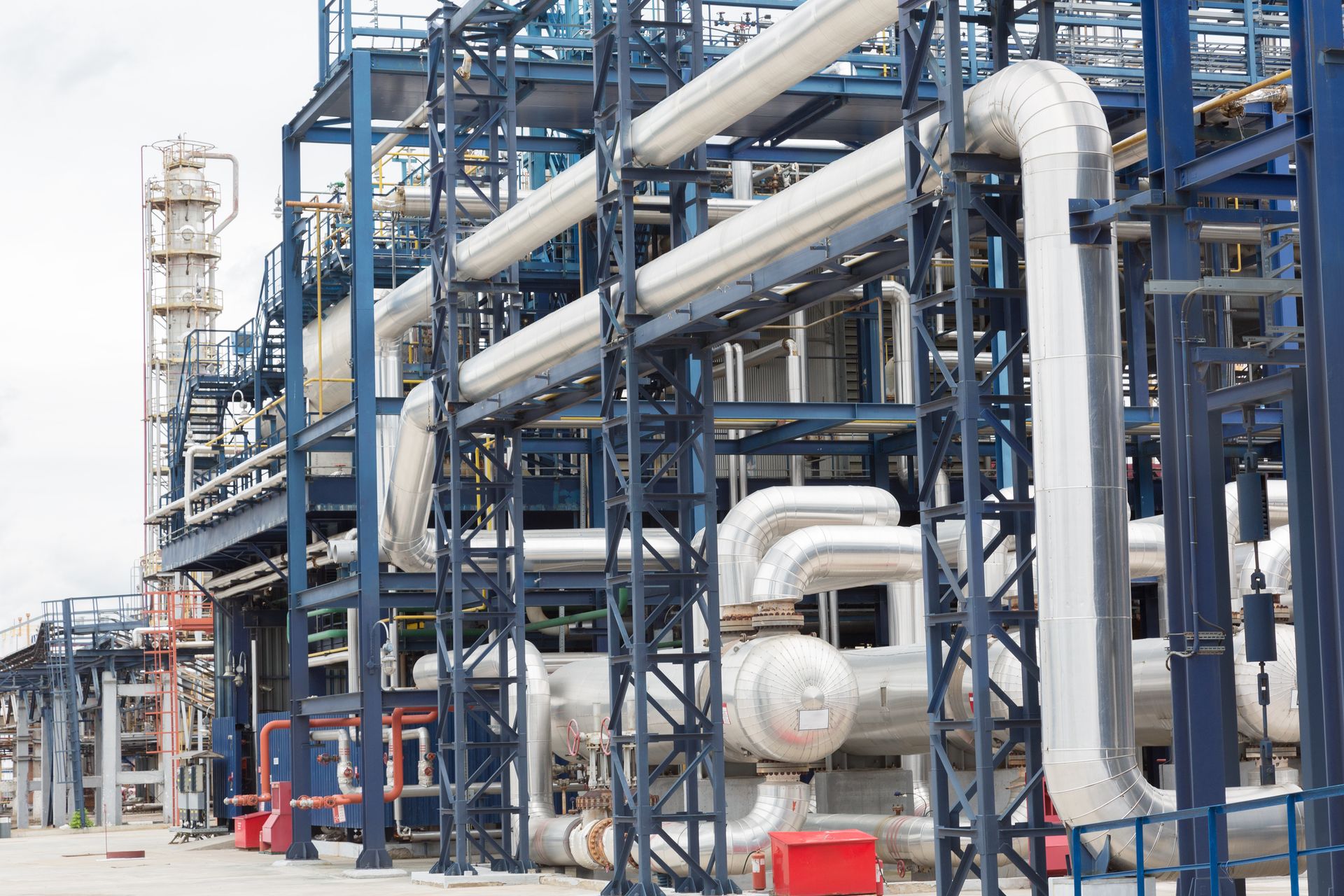
We work for operators, EPC contractors and equipment manufacturers across Europe, the Middle East, Asia, Africa and the Americas. Calculation, design and documentation are delivered remotely under the client's own document control procedure.
Where the work requires presence, inspection, supervision and application teams are mobilised to site. Materials are selected from families that are actually available in the project country, so the design does not fail at the procurement stage.
Process, cryogenic and defence work share the same method but not the same constraints. Each is handled by the discipline it requires.
Refineries, petrochemical plants, power generation, cement, mining and process industries; energy efficiency, turnaround planning and corrosion under insulation.
Heat loss and gain, personnel protection, surface temperature limits, condensation control and economic thickness across all operating ranges.
LNG, liquid oxygen, liquid nitrogen and liquid hydrogen service; vapour barrier continuity, cold bridging, boil-off and material compatibility.
Thermal protection, infrared signature management, acoustic treatment and qualification support under non-disclosure and export control discipline.
Multi-layer insulation, vacuum systems, thermal vacuum testing, outgassing limits and spacecraft thermal control.
Specification and tender review, supplier interface management, design review, witness points and acceptance on behalf of the owner.

In cryogenic service the failure does not appear on the surface; it appears inside the layer. A break in vapour barrier continuity draws moisture into the system and turns into performance loss and corrosion within months.
In vacuum and space systems the dominant mechanism changes altogether: conduction and convection retreat, radiation takes over, and multi-layer insulation performance is decided by reflector choice, compression, seams and penetrations rather than by thickness.

Engineering that cannot be built is not engineering. Since the company was founded we have never used a subcontractor on any job; the application is carried out by our own qualified and certified personnel, with our own tools and equipment.
This is why our design decisions are constructible and cost-effective: every detail we draw has been installed by the same organisation, and what the field measures is fed back into the calculation.
Industrial Insulation Catalogue
Engineering scope, calculation and documentation services, material families and application capability in a single document.
ERATHERM works as an engineering partner for operators, EPC contractors and equipment manufacturers. Calculation, design, documentation and specification work is delivered remotely under the client's document control procedure; inspection, site supervision and application teams are mobilised to site.
Yes. Thickness calculation, heat loss analysis, system design, detail engineering, specification writing and owner's engineering can each be contracted separately. The input data and the deliverable are defined for each package.
The calculation basis is agreed with the client and stated in the report. Commonly used references include ASTM C680 for heat transmission, ISO 12241 for thermal insulation of building equipment and industrial installations, and the project's own specification where it is more stringent.
Yes. We work across Europe, the Middle East, Asia, Africa and the Americas. Documentation is produced in EPC-level English under the client's document control procedure, and teams are mobilised to site where required.
No. Economic thickness optimises energy cost against material cost, but personnel protection limits, condensation control, process requirements and fire performance can all override it. The governing criterion is identified before the optimisation is run.
Yes, with our own personnel. We have never used a subcontractor on any job. The application can be taken together with the engineering under a single responsibility, or the engineering can be delivered on its own.
Geometry, process data, models and measurement records are handled under non-disclosure agreements with access control. Defence and space projects are not published as open references.
The detailed pages behind each service.
Engineering
Thickness calculation Insulation system design Detail engineering and BOM Shop drawing preparationSupervision and quality
Consultancy and field supervision Inspection, QA/QC and TPI Corrosion under insulation Turnaround and shutdownSystems and sectors
Cryogenic insulation MLI and vacuum systems Defence industry solutions Insulation materialsShare the operating conditions, line and equipment list, ambient data and acceptance criteria; we will define the calculation basis, the deliverables and the schedule.