
Closure type
Lacing, hook and loop, toggle or quick-release, chosen for the refit frequency, the operator's gloves and the access available — not for the lowest unit price.

Removable jackets are bought as a product and fail as a detail. The closure type, the seam overlap, the drain path and the template data decide whether a jacket gets refitted after the next maintenance or ends up in a skip while the valve runs bare for the following ten years.

A jacket schedule that says only size and temperature will be fabricated wrong. These are the decisions that have to be made before fabrication.
Lacing, hook and loop, toggle or quick-release, chosen for the refit frequency, the operator's gloves and the access available — not for the lowest unit price.
Seams oriented to shed water, overlapped sufficiently and positioned away from the surfaces that must stay dry. Outdoor and indoor details are not the same.
A deliberate low-point drain so that water which does enter leaves again, and an access arrangement that lets the surface underneath be inspected without destroying the jacket.
Dimensions, bolt projections, actuator and stem clearances, recorded properly. Most refit failures trace to a survey that recorded the valve size and nothing else.
The only meaningful acceptance criterion for a jacket is whether a maintenance crew will put it back on at two in the morning. Everything in the detail is judged against that.

We survey or template the actual items, set the closure and seam arrangement against the real access and refit frequency, and issue a jacket schedule with a drawing per type rather than per item — so fabrication is repeatable and the maintenance team learns one arrangement, not forty.
Issued so a fabricator can quote from it and a maintenance planner can use it without a second document.
Every item by tag, with its jacket type, size data and service condition.
One drawing per jacket type: closure, seam, overlap, drain and insulation build-up.
Measured data per item, including clearances the fabricator needs.
Insulant, facing, closure hardware and stitching, with temperature limits.
Quantities by type, suitable for enquiry and for comparison of fabricator offers.
A one-page instruction per type for the maintenance crew, with the jacket tag.
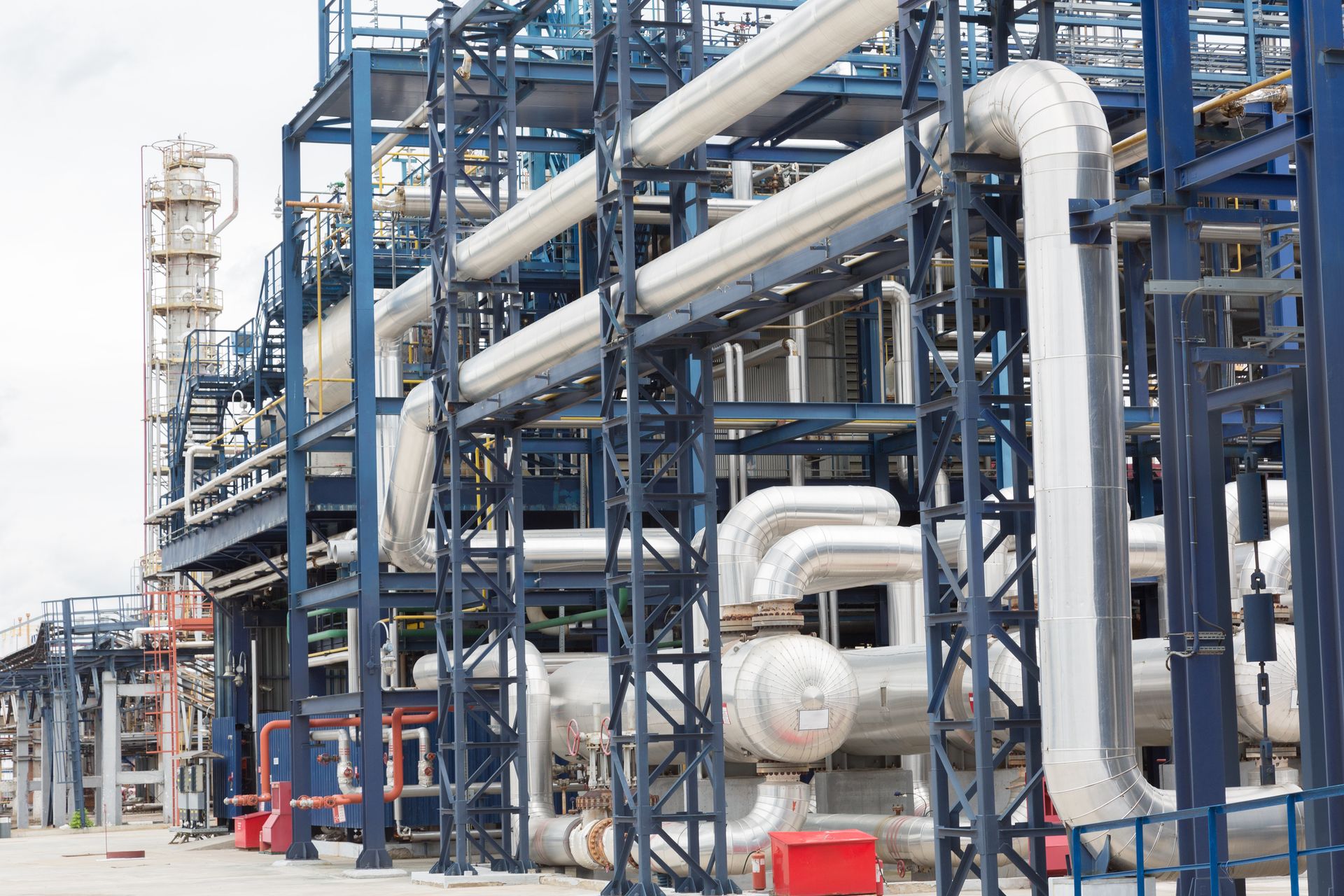
A valve body and its flanges present several times the surface area of the equivalent length of pipe, at the same temperature, with turbulent external flow around a complex shape. A line insulated to specification with every valve left bare can lose a substantial share of what the insulation was supposed to save.
Industrial Insulation Catalogue
Engineering scope, calculation and documentation services, material families and application capability in a single document.
ERATHERM works as an engineering partner for operators, EPC contractors and equipment manufacturers. Calculation, design, documentation and specification work is delivered remotely under the client's document control procedure; inspection, site supervision and application teams are mobilised to site.
Almost always a closure that is awkward with gloves, a jacket that was never tagged to its valve, or a fit that was wrong from the first refit. All three are detail decisions made before fabrication, which is why the survey and the closure selection matter more than the material.
Yes, without exception on anything above a handful of items. An untagged jacket in a store is scrap, because nobody will spend time working out which valve it came from.
On cold service with careful vapour barrier detailing, yes. On deep cryogenic service the vapour sealing requirement usually makes a removable arrangement impractical, and we will say so rather than supply something that will wet itself within a season.
Usually, and the calculation is quick. We quantify loss per item against fabricated cost and rank it; on hot service with accessible valves the payback is typically short enough that the ranking matters more than the decision.
Jacket details sit between the thickness calculation and the shop drawings.
We will rationalise the jacket types, detail the closures for the access you actually have and return a schedule a fabricator can quote from.